


There’s a gap in how we treat sexual trauma that we rarely talk about. And it matters because sexual assault happens to 1 in 3 women worldwide (World Health Organization, 2017) and to a person in the US every 73 seconds (RAINN). Roughly 90% of survivors are women and 10% are men, according to a National Crime Victimization Survey in 2013.
Therapists are trained to help you heal, but there’s an element to what comes next that is often missed: how to have a passionate relationship again. How to feel pleasure in your body without bracing. How to want.
This week’s guest built her entire career inside that gap.
Dr. Holly Richmond is a somatic psychotherapist, sex therapist, and the author of Reclaiming Pleasure, a book I often refer to and recommend. She is also my dear clinical supervisor.
Holly is the person I bring my toughest client cases to, so getting to sit across from her and having this honest conversation was a personal highlight of this season.
Holly spent her 20s and early 30s as a journalist—celebrity profiles, health, beauty—and in a sexless marriage. Rigid, shut down, somaticizing everything (”it would be my knees one week, then my stomach, then my shoulder—and there was never anything wrong”).
She describes herself as worse than the most disconnected clients who now walk through her door, the ones who say they don’t care if they ever have sex again.
And then, through a creative writing class of all things, everything changed. For years she credited the man she met there, now her husband of 18 years.
But as she puts it in the episode: it wasn’t Danny who saved her life. Sex saved her life. Eros. Vitality. The choice of possibility over the comfortable, safe, dead life she had built.
We go deep into how she—and the hundreds of survivors she’s worked with since—rebuilt from there.
You can tune in on YouTube, Spotify, and Apple Podcasts.
Here are the highlights:
Control, pleasure, connection
Holly’s framework for reclaiming your sex life after trauma came out of her doctoral research, and it moves in a specific sequence.
Control comes first, but not the way you’d think.
Most survivors arrive already hyper-controlled: vigilant, rigid, excellent at keeping themselves safe. The work isn’t building control, nor losing it or giving it up. It’s learning to relinquish it, gradually, on your own terms.
Pleasure comes second, and it starts with discovering your sexual template: what do you actually like?
Desire (the psychological process of wanting) and arousal (the physiological one) get mapped slowly, and not just sexually—through food, movement, music, anything that brings you back to aliveness. You cannot access sexual pleasure if you aren’t experiencing pleasure anywhere else in your life.
Connection comes last, and it’s the phase where you “have to go out into the world and do this.” If you’re partnered this can look like exercises you’ll apply together, but it’s also an exercise in integrating into the community, whether that’s volunteer work or a sports hobby, for example.
If you’re interested in reading her book Reclaiming Pleasure, you can purchase it here.
The body doesn’t keep the score
Bessel van der Kolk’s The Body Keeps the Score brought somatic trauma work into the mainstream, and recent research—the Friston paper—has challenged parts of it.
Holly agrees that the body does not store trauma. It’s not sitting in your tissues.
What the body does is express trauma. It has a story to tell.
And that distinction isn’t semantic—it’s the difference between “you are stuck with this” and “your body is trying to communicate something we can work with.”
It goes back to something Esther Perel said that Holly carries with her: words inform our experience. Victim versus survivor. Existing versus living. Stored versus expressed.
The language we use about our own healing changes what feels possible.
Safety is a process, not a place
Couples get the safety-risk balance wrong when they conflate safety with comfort.
Safety is not a state you arrive at and stay in. No one moves through the world with a permanently regulated nervous system. What we’re actually after is flexibility: that middle territory between rigidity and chaos where play, risk, and desire live.
And here’s the uncomfortable truth for long-term couples: when everything becomes familiar, familial, and frictionless, you haven’t built safety. You’ve built comfort. And comfort, left unexamined, is where desire goes quiet.
To that I’d add my own observation from my practice: couples also conflate safety with a lack of communication.
“We talk about everything” often means “we’ve agreed not to say the things that would hurt.”
Holly shared a Ram Dass line I loved:
Most couples make a contract I won’t hurt your ego if you don’t hurt mine. Healthy couples make a contract to tell the truth.
Your “forbidden” fantasies make sense
Many survivors of sexual trauma—overwhelmingly women—have forced seduction fantasies. And nearly every one of them believes they are the only one, and that something is deeply wrong with them.
Holly has heard this fear so often in her practice. Her answer is always the same: it makes complete psychological sense. These fantasies are about control: you are the author, the architect, the one deciding everything inside the safety of your own mind. Far from being evidence of damage, they’re often the psyche playing with the very thing it’s healing.
Nothing is wrong with you. You are not broken. And your fantasies are information, not indictments.
Additional practical advice
If you lose the moment during sex, like a stray thought, a noise, your to-do list, reframe it as not having lost it, but rather paused it.
Go back through sensation: your partner’s hands, your breath, how touch feels on your own skin. Ask for what brings you back (”stroke my hair,” “grab my hips tighter”). Presence is the doorway, and pleasure follows.
Say yes to something. Holly shared a practice from her own marriage: when her husband initiates, she tries never to reject him outright, but she doesn’t say yes to sex every time either.
She checks in: what can I say yes to? A long hug. A kiss. Sometimes more.
It keeps the channel of touch open without obligating anything, and it protects both partners from the corrosion of constant rejection.
Reintroduce touch without expectation. For so many long-term couples, touch only happens when sex is being initiated, which teaches the lower-desire partner to flinch at a hug in the kitchen. Affectionate touch with no agenda is, in Holly’s words, a female libido healer.
Go for day sex. Estrogen is higher in the morning through mid-afternoon. If you’re waiting until 9:30pm—after work, after kids, after everything—you’re not initiating sex, you’re pushing a boulder. Stop having leftover sex.
And for the touched-out mother: 20 minutes a week. A self-pleasure protocol that starts with nothing more than your own hands moving from your toes to the top of your head, in a way that feels good to you. That’s different from masturbation. It’s a slow reclaiming of your body as yours, so that touch with your kids, your partner, and yourself can live in different containers.
We dive into so much more, including my own past with sexual trauma and how that manifested later in my life, so I hope you enjoy this episode. It’s deep, and uplifting.
Last year, I published a recap of my event with Holly. You can read it here:

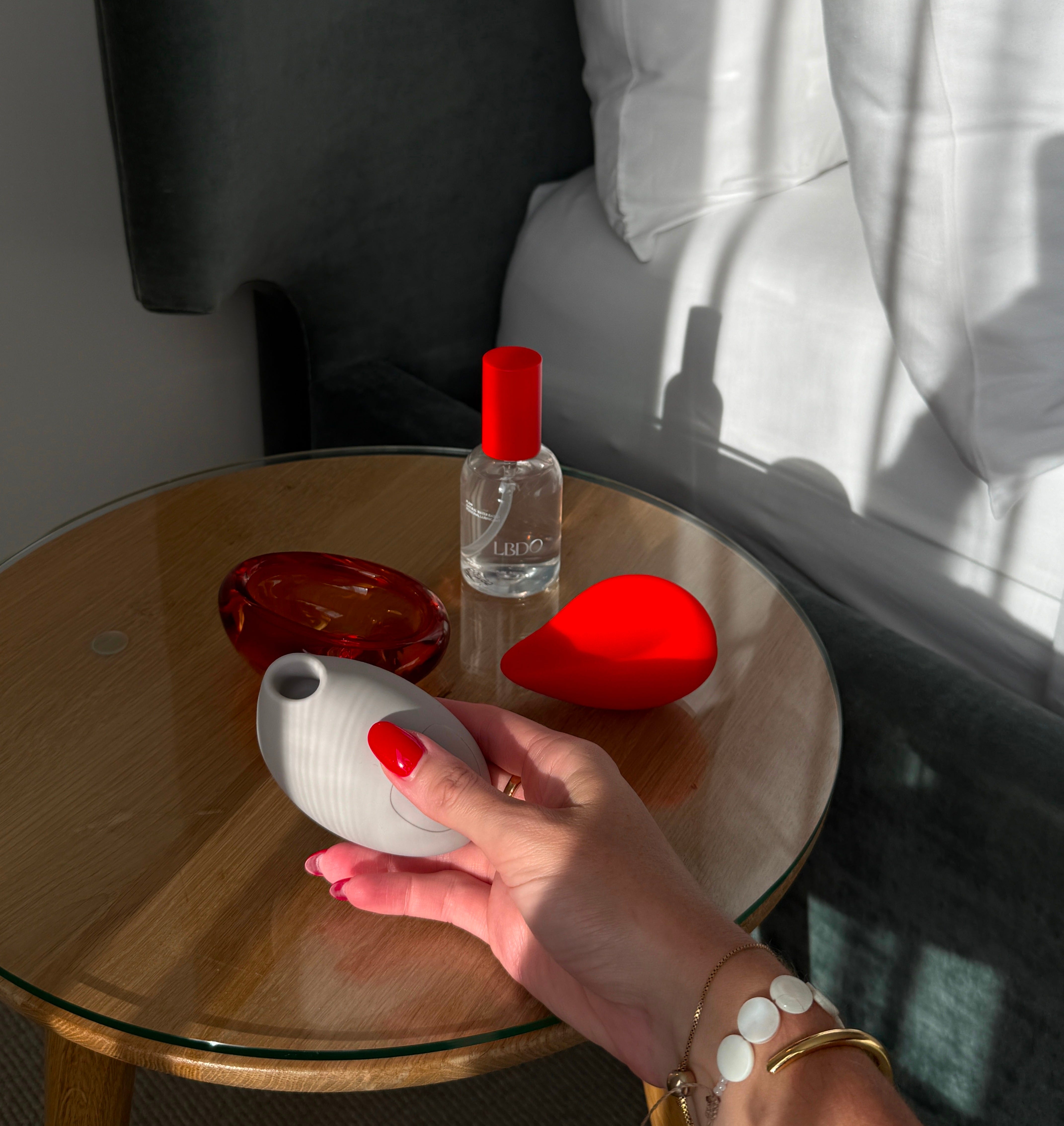
Holly's self-pleasure protocol starts with your own hands, and when you're ready to expand from there, what you reach for matters.
My own nightstand staples are from LBDO. Melt, their massage candle that melts into a warm oil (this is exactly the kind of slow, no-agenda touch Holly prescribes), and Rush, their air-pulse stimulator that took three years to design and lives in a glass base so beautiful I've never once thought about hiding it in a drawer.
If reclaiming pleasure is your work right now, they're a gorgeous place to start and you can explore more at lbdo.com — use code LUST15 for 15% off.
In case you missed it, tune in to the last episode or read the highlights here:
Lust in Translation is independently produced and self-funded.
If you shop any brands I share, using my links and discount codes is the best way to financially support this work. I promise I only feature products I actually use and believe in.
If you love what you’re reading and watching, please share with anyone else who would too. Spreading the word helps us grow and bring you even better content.


