


What do you do when you want something in the bedroom that your partner doesn’t—or that you’ve never been able to say out loud?
That question sits at the heart of this week’s episode, and there’s almost no one better to answer it than my guest, Amanda Dames—better known as The Kink Consultant.
Amanda is a sexologist and Somatica-certified sex and relationship coach. But before all of that, she lived one of the more fascinating double lives I’ve come across: by day, she worked at the Wall Street Journal. By night, she was a professional dominatrix in a New York City dungeon.
For years, she was the person powerful men trusted with the desires they’d never spoken aloud to anyone. And what she learned in that dungeon completely reshapes how most of us think about kink, shame, and desire.
“These were powerful men—men with high-income jobs. If you looked at them, you’d think they had everything. But they were missing one thing.”
Here’s the through-line of our whole conversation: your desires aren’t proof that something is wrong with you. They’re information about a deeper emotional need.
Or, as Esther Perel says, they reflect a problem and a solution: what you want and how to get it.
The work was never about fixing what you want. It’s about understanding the feeling underneath it, releasing the shame around it, and learning to ask for it.
We talk about her journey from the dungeon to The Kink Consultant, the psychology of what powerful people really crave, and—most importantly for so many of you—how to actually bring kink into a long-term relationship without it blowing up in your face.
Besides Substack, you can tune in on Youtube, Spotify, and anywhere else you listen to podcasts.
Below are 6 key insights from our episode.
1. First, what’s the difference between a kink and a fetish?
We tend to use these words interchangeably, but a kink is a nice-to-have—something that turns up the heat. A fetish is something you need to think about in order to orgasm; it compels you.
And here’s the part that surprises people: “kinky” is defined almost entirely by the status quo, which is constantly moving.
As Amanda points out, blow jobs were once considered kinky. What counts as “normal” is just a target that shifts by culture and by decade—and anything outside the current default reads as kinky.
2. No one is broken.
One of the most common fears Amanda hears is, is my kink tied to some trauma? It can be—but the research shows it usually isn’t.
Sometimes a desire imprints from something as innocent as a childhood moment that had nothing to do with sex. Sometimes there’s no clear origin at all. Her point, and mine: the hunt for “why am I like this” often matters far less than simply accepting that you are.
As long as it’s consensual and pleasurable (some derive pleasure from pain), then it’s all good.
3. What powerful men are really looking for.
The clients who filled Amanda’s calendar were often high-powered decision-makers—the people who run things all day, every day. What they came looking for wasn’t sex (in the dungeon, there is no sex and no kissing). It was the chance to surrender.
But underneath even that was something far more human: they wanted to be seen.
That need—to be witnessed without judgment—is the real engine underneath most desire.
4. To bring kink into your relationship, start outside the bedroom.
This is the question so many of you wrote in about. When one partner is kinky and the other is hesitant (or doesn’t even know yet), Amanda’s framework is to build a bridge to each other—and, crucially, she begins that work outside the bedroom.
Her unforgettable example: do you know that when you take out the garbage, you have to replace the garbage bag? You cannot fully surrender to a partner in the bedroom if you don’t trust them to show up for you outside of it. The mental load, the division of labor, whether each person feels supported—all of it shapes what’s even possible erotically.
A few of her principles:
Both partners’ desires matter. If a couple comes to her about his kink, she won’t move forward until she knows what she wants, too. You can’t build a bridge for one person.
The stressed partner’s desire tends to come last. Often the wife (and mother) is carrying so much that her own wants land dead last. Sometimes the real work is simply uncovering that her desire exists at all.
Trust outside the bedroom is the foundation for surrender inside it.
5. How to actually bring it up to your partner.
If there’s one section to screenshot, it’s this. Amanda’s guidance on starting the conversation:
Pick the right moment. Not in bed, not right before sex, not when they’re busy or distracted. Choose a calm, connected time—morning coffee, a quiet evening.
Lead with curiosity, not a confession. Don’t dump your fantasy on them. Open the door instead: “Have you ever had a fantasy you’ve wanted to explore?” And if they share something, listen. If they don’t, you can share a part of the fantasy you’re wanting to explore, and see how they react to that fraction of it.
Share the feeling, not just the act. This is the key. Don’t only present the what—present the why. Instead of “I want to be tied up,” try: “I want to try bondage because I think it’ll make me feel safe and held.” Feelings are relatable, even when a specific kink isn’t.
Give them a next step. End with an invitation: “Would you be willing to explore this with me?”
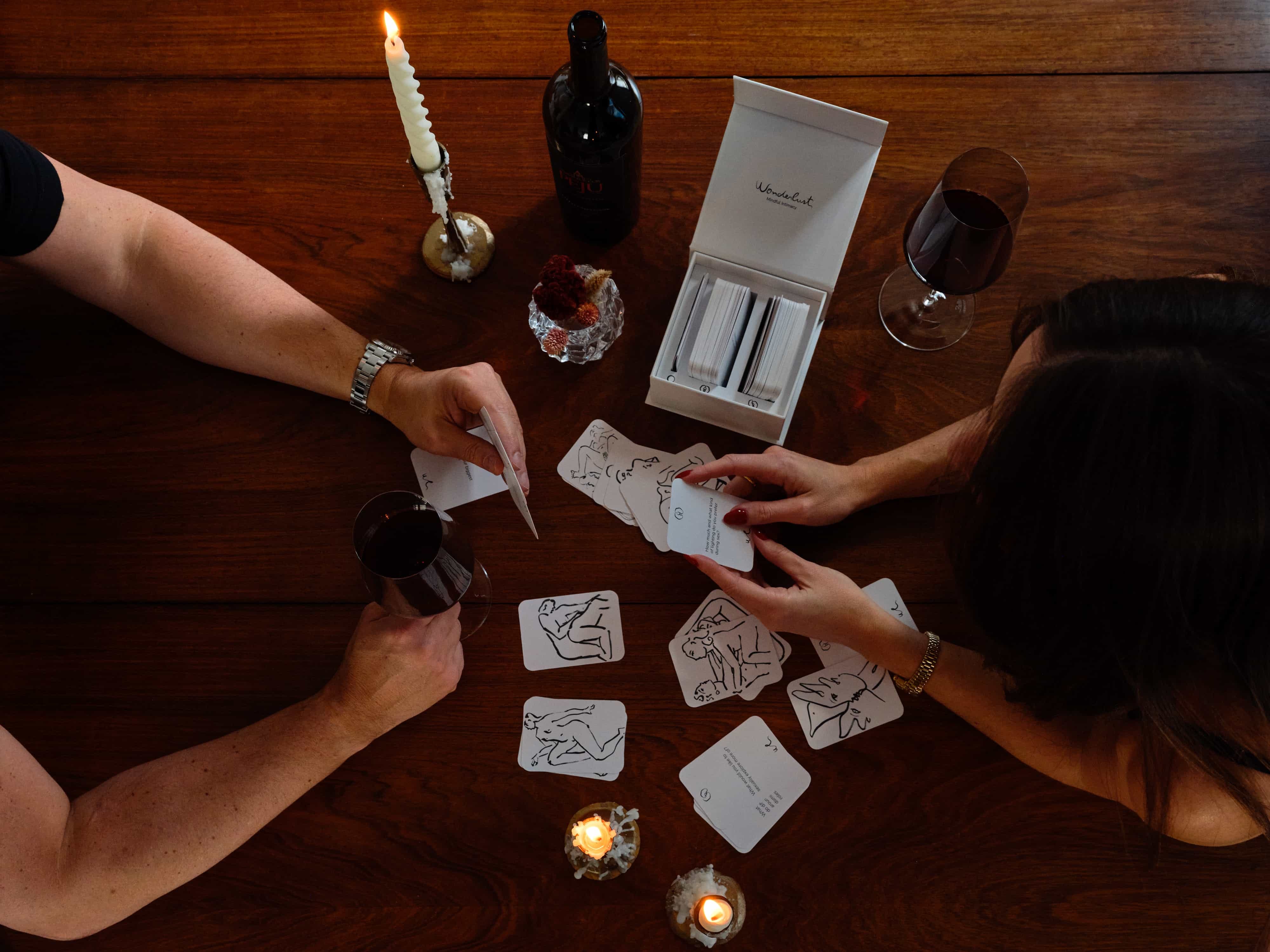
If the hardest part is starting the conversation, that’s precisely why I created the Wonderlust Intimacy Card Deck. It lets the card ask the question, so you don’t have to—turning these tender, vulnerable conversations into something closer to an intimate game night. You warm up on the lighter prompts and work your way toward the seriously spicy ones, at your own pace.
6. If you’re brand new, go from zero to one—not zero to ten.
Curious but intimidated? Amanda’s rule is to try the entry-level version of anything before you dive in.
Impact play? Start with a hand, not a heavy implement.
Bondage? Skip the metal handcuffs. Reach for silk ties or even Velcro cuffs—something that comes off easily.
Want the gentlest on-ramp of all? A blindfold. It builds anticipation, quiets a busy mind, and lets you practice surrender. (It’s one of my personal favorites—and if you’re someone who can’t stop thinking during sex, it’s a gift.)
Curious about something more advanced, like Shibari? Learn from a practitioner. Ropes are stunning, but they can get dangerous.
If this episode speaks to you and you want to go deeper, you can work with Amanda or explore her courses at amandadames.com, and find her on Instagram at @the_kinkconsultant.
In case you missed it, tune in to last week’s episode or read the highlights here:
Lust in Translation is independently produced and self-funded.
If you shop any brands I share, using my links and discount codes is the best way to financially support this work. I promise I only feature products I actually use and believe in.
If you love what you’re reading and watching, please share with anyone else who would too. Spreading the word helps us grow and bring you even better content.


