


A couple I worked with—I’ll call them Daniel and Mara—came to me describing what they thought was a desire problem.
His version: I initiate, she sighs, so I’ve stopped initiating.
Hers: When he reaches for me, just thinking about getting in the mood feels like a lot of effort.
So I asked Mara: when you have sex, do you enjoy it? She didn’t hesitate. “It’s great. I can’t remember a time I regretted it once we got going.”

That answer told me this wasn’t necessarily a desire problem, but rather a transition one dressed up as desire.
Last week I wrote about sexual initiation, and how we often struggle because we tend to reach for a partner in our own language instead of theirs.
But what happens on the other side of that moment, when your response is often shaped by your struggle to context switch? What could make all of this easier?
That’s what I want to talk to you about today.
The sigh has a name: adaptability.
Adaptability is how easily you adjust to changes and transitions. It’s a trait that determines how intuitively you respond to your partner with emotional engagement, rather than with criticism, problem-solving or a simple “no.”
In Daniel’s case, he changes channels cleanly. He can close his laptop and be fully in the next thing before the screen goes dark.
Mara, on the other hand, buffers.
Every transition in her life has a loading screen: leaving the house, ending the workday, focusing on a presentation. Each switch costs her something, and she feels the cost before she has consciously decided anything.
Some of us are more Mara, and some are more Daniel.
When Daniel reaches for her at 9 PM, mid-episode, her body does the math: the cost of leaving the show, the mental tab of tomorrow’s meeting, the mom-mode she’d been in since 6 AM—and the long trip from allllll of that to a sexy state of mind. What escapes her is a sigh.
Daniel hears “not you again.” What she means is “the switch is expensive.”
A no answers the question of sex in that moment, and that’s a completely legitimate thing to answer. Nobody owes anybody a yes.
But what goes unaddressed is the feeling underneath the ask. An initiation is a bid for connection. More specifically, it’s a bid that falls under one of these four reasons for wanting sex.
The missed opportunity therefore isn’t the sex, but the emotional engagement.
How the two of you handle the no, and whether you can talk about the yes or the no and how you each feel about it, is where trust gets built or eroded.
“Trust is so much the foundation of any connection that the absence of trust is essentially the absence of connection,” writes Dr. Emily Nagoski in Come Together.
What exactly are we talking about, when we talk about trust?
Sex therapist Dr. Sue Johnson frames trust as a question: A.R.E. you there for me? Are you emotionally Accessible, Responsive, and Engaged?
A no to sex can be all three. “Not tonight” coupled with “but I love that you want me. Can we plan for tomorrow?” is accessible, responsive, and engaged.
Dr. John Gottman’s definition takes this a step further: trust is what accumulates when both of you keep choosing, over and over, to make things easier for the other, even when it costs you something to do it.
Mara’s cost: the transition.
Daniel’s cost: the patience with the transition.
Here's how each of them put that into practice, and what changed when they did.
Whenever you’re ready, here are 2 ways I can help:
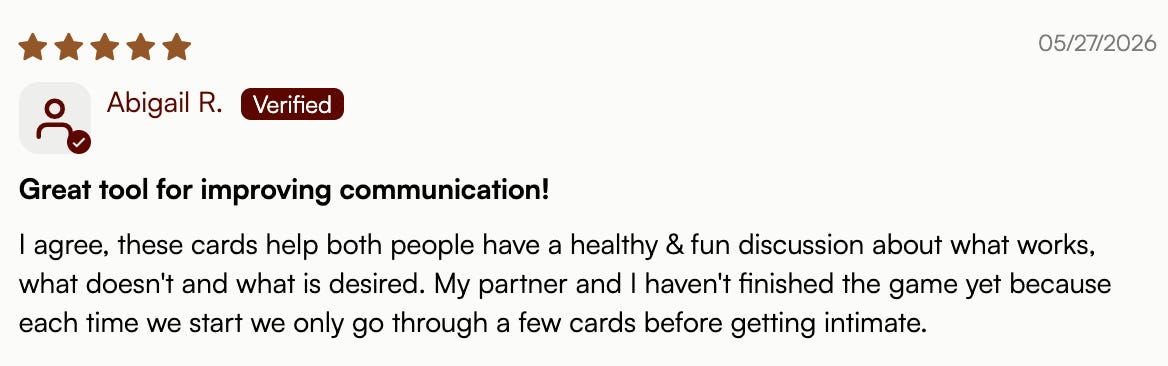
Couples Intimacy Card Deck - Turn each other on, one question at a time. I created this for you and your partner to bring more connection, curiosity, and play into the bedroom. Get 10% off with code LUST.
Book a 1:1 Session - I help individuals and couples in long-term relationships find more desire, confidence, and connection—in and out of bed. Start with one session and a clear plan for what to do next.
“Our sessions with Natassia became the foundation for a stronger sexual and intimate connection. We experiment more, feel safer with each other, and it shows in every part of our relationship.” — George S., 4-yr relationship
Thank you for reading Lust in Translation! If you think anyone else would enjoy reading this too, please share it with them.
For actionable insights, including weekly frameworks & personal challenges pulled from my work with clients, click below to become a paid subscriber.
makes so much sense! Great suggestions!!